Showing posts with label food. Show all posts

Monday, 13 February 2012

most important ingredients you must know..

Make sure your diet includes these healthy super foods

1. Olive oil

Press an olive and you get one of the healthiest fats in the world. The main benefit of olive oil, and there are many, is that it lowers “bad” LDL cholesterol and raises “good” HDL cholesterol, thanks to its monounsaturated fats. Olive oil is also packed with antioxidants called phenols, which may protect artery walls from cholesterol buildup.
Researchers even discovered recently that olive oil acts as an anti-inflammatory, which further protects your heart, and the rest of your body, too. Inflammation is strongly linked not only to heart disease but also to type 2 diabetes, Alzheimer’s disease and cancer.

2. Beans

Beans are good for your heart, thanks in large part to their soluble fibre, which soaks up cholesterol so the body can dispose of it before it can stick to artery walls. Studies find that diets high in soluble fibre can cut total cholesterol by 10 to 15 percent. The same soluble fibre, combined with beans’ protein, makes beans beneficial to blood sugar. Their magnesium helps relax arteries, giving blood more room to flow and lowering blood pressure. Finally, a recent study ranked beans among the top antioxidant foods.

3. Broccoli

Consider broccoli your number one cancer fighter, thanks to its sulfur compounds, such as sulforaphane, which you can smell as broccoli cooks. These compounds signal our genes to boost production of enzymes that detoxify potential cancer-causing compounds. Eat more broccoli, and you could slash your risk of everything from breast and lung cancer to stomach and colon cancer by as much as half.

Sulforaphane has also been found to kill the bacteria that cause ulcers. Broccoli’s also a surprising nondairy source of calcium and potassium, making it good for your bones as well as your blood pressure. Its vitamin C and beta-carotene protect your eyes from cataracts and safeguard your brain cells from memory-robbing attacks by free radicals.

4. Garlic

Garlic has antibacterial, antifungal and antiviral properties; it even appears to banish some antibiotic-resistant bacteria, at least in test tubes. Most of its disease-fighting potential comes from its sulfur compounds, which act as antioxidants, providing many of its cardiovascular benefits. Garlic lowers cholesterol only modestly, but it also acts as a blood thinner, reducing the formation of blood clots and your risk of heart attack and stroke. Just six or more cloves a week can slash your risk of colorectal, stomach, and prostate cancer in half, compared to eating one clove a week or less. The sulfur compounds flush out carcinogens before they can damage cell DNA, and they force cancer cells that do develop to self-destruct.

5. Dark chocolate

Dark chocolate contains hefty amounts of disease-fighting flavonoids, antioxidants also found in red wine and many fruits and vegetables. In fact, it appears to have more flavonoids than any other food. Studies find its antioxidants can improve blood pressure, prevent blood clots, slow the oxidation of LDL cholesterol and reduce inflammation. Some research suggests that eating 45 g a day can cut heart attack risk by 10 percent.
Eating dark chocolate can also lower insulin resistance, the main problem behind diabetes.

the top 5 of malaysian food that we should try..!!

 Malaysian consists of 3 major ethnic groups with Malays the majority and followed by Chinese and Indian community. With this multi-ethnic, multi-culture and multi-lingual society, we are lucky to have vast varieties of local foods from multi cuisine and not limited to fusions of them. What I’m going to pick here as my choice of Top 5 local foods are also from these 3 major ethnic community. Without tasting them just to mean that you have not really experienced the true Malaysian. :)
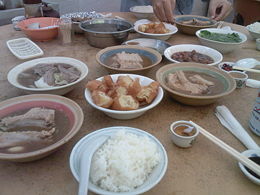
  1. 260px-bak_kut_teh_zz Bak kut teh - A Chinese herb soup that can direct translates as “pork bone tea” It consists of meaty pork ribs in a complex mixes of herbs and spices (including star anise, cinnamon, cloves, dang gui, and garlic), boiled together for hours. It is believed could warm your body and refresh your sleeping mood. Bak Kut teh is usually eaten with rice, and often served with youtiao (strips of fried dough) for dipping into the soup. Soy sauce is preferred as a condiment, with which chopped chilli padi and minced garlic is taken together. Don’t ever forget to drink Chinese tea tohether with your Bak Kut Teh which could help to dilute or dissolve the fat content of meat. Bak kut teh is typically a famous morning meal originally from Klang, Selangor, the home of bak kut teh. Currently, you could find Bak Kut Teh many places all around Malaysia with lots of variants. For RM 10.00, you could order a sinlge portion inclusive of 1 claypot of Bak Kut Teh and 1 bowl of rice.
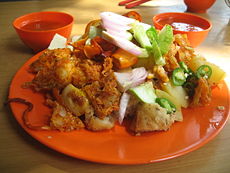
  2. 230px-indian_rojak Rojak - A fruit and vegetable salad dish commonly found in Malaysia. The term “Rojak” is Malay for mixture, is also used as a colloquial expression for an eclectic mix, and in particular is often used to describe the multi-ethnic character of Malaysian. Chinese rojak contains mainly local fruits such as mango, pineapple, pomelo with cucumber, prawn friitters mixed with spicy shrimp paste sauce. Penang is one of the famous place for this wonderful salad dish. While Indian rojak contains fried dough fritters, bean curds, boiled potatoes, prawn fritters, hard boiled eggs, bean sprouts and cucumber mixed with a sweet thick, spicy peanut sauce. Traditionally, rojak vendors use modified sidecar motorcycles as preparation counters and to peddle their rojak. These mobile vendors now use modified mini trucks which you could find a lot of them along the street. Off course you could also try out these salad in any of the indian or mamak shops or ‘pasar malam’ (night flea market)in Malaysia. Normally, it would cost RM3.00 per portion.
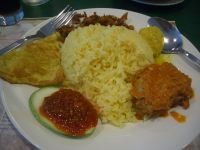
  3. 200px-nlemak2 Nasi lemak - The unofficial national dish of Malaysia. With roots in Malay culture, its name is a Malay word that literally means ‘rice in cream’. The name is derived from the cooking process whereby rice is soaked in rich coconut cream and then the mixture steamed. Sometimes knotted screwpine (pandan) leaves are thrown into the rice while steaming to give it more fragrance. Traditionally, Nasi Lemak serves in banana leaves as a platter with cucumber slices, small dried anchovies (ikan bilis), roasted peanuts, hard boiled egg and hot spicy onion sauce (sambal). Nasi lemak can also come with any other accompaniments such as chicken, cuttlefish, cockle, beef curry, beeflungs where all are spicy in nature. You could try this basically everywhere in Malaysia. Depends on the accompaniments and size of portion, it cost from RM1.00 to RM6.00 normally. My bet is to try out those packed with banana leaves in small portion which cost only RM1.00 and they are really delicious. 
  4. 180px-laupasat_satay Satay - Chunks or slices of dice-sized meat (chicken, mutton, beef or pork ) on bamboo skewers (although the more authentic version uses skewers from the midrib of the coconut leaf). These are grilled or barbecued over a wood or charcoal fire, then served with a spicy peanut sauce dip, or peanut gravy, slivers of onions and cucumbers, and ketupat (rice cakes). In Malaysia, satay is a popular dish – especially during celebrations – and can be found throughout the country. Turmeric is a compulsory ingredient used to marinate satay and to give it a characteristic yellow color, especially for Beef, Chicken, Mutton and Pork. It can be found throughout every state in Malaysia. Besides restaurants that serve satays, one can find hawkers selling satay in food courts and Pasar malam. The famously known satay outlets are in Kajang, Selangor which dubbed as the Sate City in the country. Sate Haji Samuri is very popular in Kajang as well as throughout Malaysia. One stick of Satay costs normally RM0.50 and bet you could easily eat more than 5 sticks in one go!
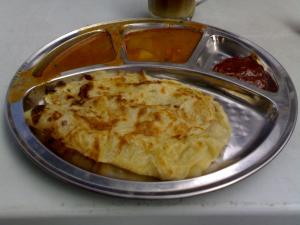
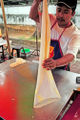
  5. 110720081264 80px-making_roti_canai Roti canai - A type of flatbread or better known as roti prata. Roti means bread in Malay. The term “canai” derives from “Chennai”, a region in India which is formerly known as Madras. In English, roti canai is sometimes referred to as “flying bread,” a term that evokes the process of tossing and spinning by which it is made before frying on the hot pan. The ideal roti is flat, fluffy on the inside but crispy and flaky on the outside. Roti Canai is normally served with beans curry, fish curry or mint source. Some may like to dip it into sugar. One of the characteristics of roti canai and its derivatives is that it can be eaten with the hands, without the need for utensils. It is a convenient dish to consume, while being filling. This characteristic makes it a dish of choice as breakfast or as late night supper. Roti canai costs normally RM1.00 a piece, making it extremely popular. You could try this dish in all mamak restaurants everywhere in Malaysia.
Well, although I have only listed the Top 5, there are so much more delicious local foods you could also try out in Malaysia such as Char Kuoy Teow (chinese fried noodle), Pisang Goreng (deep Fried banana), deep fried sweet potato, Nasi Kandang, Asam Laksa, Har Mee (Prawn noodle), Nasi Paprik, and so on.

The Best Countries of Food

Food and travel go together like planes and airports. No matter where you go you’ll have little trouble finding at least one culinary experience that will help you understand the local culture. In some countries the food is the highlight, drawing many a foodie to its borders, like a moth to a flame. Here are 11 countries (in no particular order) that your taste buds will thank you for visiting.

1. Thailand


Image by jaaron
Standing at the crossroads of India, China and Oceania, Thai cuisine is like a best-of of all three’s techniques and ingredients. Dishes generally go in hard with garlic and chillies (especially the phrik khii nuu variety, which literally translates as ‘mouseshit peppers’). Other signature ingredients include lime juice, coriander and lemon grass, which give the cuisine its characteristic tang. Legendary fish sauce or shrimp paste looks after the salt.

2. Greece


Image by Klearchos Kapoutsis
From olives to octopus, the true taste of Greece depends on fresh, unadulterated staples. Masking or complicating original flavours is not the done thing, especially when you’re dealing with oven-fresh bread, rosy tomatoes and fish fresh from the Mediterranean. The midday meal is the main event with a procession of goodies brought to the table as they’re ready. With Wednesday and Friday traditionally reserved as fast days (ie no-meat days), vegetarians are also looked after.

3. China


From back-alley dumpling shops to four-star banquet halls, China has one of the world’s finest palates. Cultural precepts of Yin and Yang (balance and harmony) are evident in the bowl: with food for the day including cooling foods such as vegetables and fruit to counter warming spices and meat. The Chinese revere rice but also choose noodles, with either almost always accompanying a meal. A range of regional specialities exist, variously influenced by geography and history.

4. France


Image by Sunfox
From cheese and champagne to snails and baguettes, the French are famous for their foodstuffs. French cuisine has long distinguished itself for dallying with a great variety of foods. Each region’s distinct climate and geography have influenced the array of regional specialities. Many in France consider lunch as the day’s main meal, though the two hour marathon meal is increasingly rare. The crowning meal is a fully fledged home-cooked dinner comprising six distinct plats (courses).

5. Spain


Image by scaredy_kat
Best in Barcelona, Catalan cooking is racking up the accolades from gourmands around the globe. Like other regional Spanish cuisines, Catalan cooking favours spices such as saffron and cumin, as well as honeyed sweets. A mixture of ingredients and traditions adds flair to Barcelona’s fare: using seafood and meats in a rich array of sauces. Dinner is the main event, but never before 9pm.

6. Mexico


Image by chargrillkiller
Would you like some magic-realism with that enchilada? The Mexican sensibility for enchanting influences is also brought to the table in its food, particularly during celebrations. Mexican cuisine has an overriding Spanish influence, with a twist of French and African thanks to its history. Corn and bean-based dishes are prominent – prepared in a multitude of world renowned ways including tacos, enchiladas and quesadillas. And who could forget the worm that waits at the bottom of a bottle of Mezcal?

7. Italy


Image by Allerina and Glen MacLarty
Its food is arguably Italy‘s most famous export, and it’s with good reason that the world wants it. Despite all the variations that exist between regions, some common staples bind the country’s culinary creations. Think thin-crust pizza and al dente pastas and risottos. And to drink? One word: coffee. The Italians do it best – from perfecting a distinguished roast to the gentle extraction of its essence into the cup. Perfecto!

8. India


Image by maintenancepic
India’s protean gastronomy changes shape as you move between neighbourhoods, towns and states. The basis of all meals is rice in the south, and roti in the north. These are generally partnered with dhal, vegetables and chutney. Fish or meat may also be added. Whatever the ingredients: the dish usually contains a heady cast of exotic spices that make the taste buds stand up and take notice.

9. Japan


Image by jetalone
If you can wrap your tongue around pronouncing the menu, Japan’s cuisine is a most rewarding mouthful. Most Japanese restaurants concentrate on a specialty cuisine, such as yakitori (skewers of grilled chicken or veg), sushi and sashimi (raw fish), tempura (lightly battered and fried ingredients) and ramen noodle bars. The pinnacle of Japanese cooking, kaiseki (derived as an adjunct to the tea ceremony), combines ingredients, preparation, setting and ceremony over several small courses to distinguish the gentle art of eating.

10. Indonesia & Malaysia


Image by paularps
Indonesian and Malaysian cuisines are one big food swap: Chinese, Portuguese, Indian, colonists and traders have all influenced their ingredients and culinary concepts. They are nations well represented by their food. The abundance of rice is characteristic of the region’s fertile terraced landscape, the spices are reminiscent of a time of trade and invasion (the Spice Islands), and fiery chilli echoes the people’s passion. Indonesian and Malaysian cooking is not complex, and tastes here stay separate, simple and substantial.